
Your Review Response Strategy Is Costing You Revenue—Here's the Proof

The hospitality industry has been making this mistake for decades. Every other industry just started making it too. In banks, retailers, and boardrooms: the moment a brand takes a warm, emotional customer and cools them down with a corporate template.
Research published in Harvard Business Review, October 2025. The data showed a 33% revenue gap. But it didn't show what I've watched happen in real time: the moment a brand takes a warm, emotional guest — and cools them down with a corporate template.
Most hospitality brands optimize review responses for the wrong audience.
They write for Google's algorithm. For prospective guests reading reviews six months later. For brand perception management.
They forget the person who actually wrote the review.
I coach companies on genuine human experience. My background is hospitality—so when someone takes time to write about their experience, the last thing I want is for brands to cool them down with a corporate template.
But that's exactly what most properties do.
The Emotional Betrayal Hiding in Plain Sight
A guest writes a 10-star review. Emotional. Personal. Full of specific details—rose petals, champagne, the fragrance they miss from their room.
The property responds: "Dear Guest, thank you for choosing our hotel. We're delighted you enjoyed your stay. We look forward to welcoming you back."
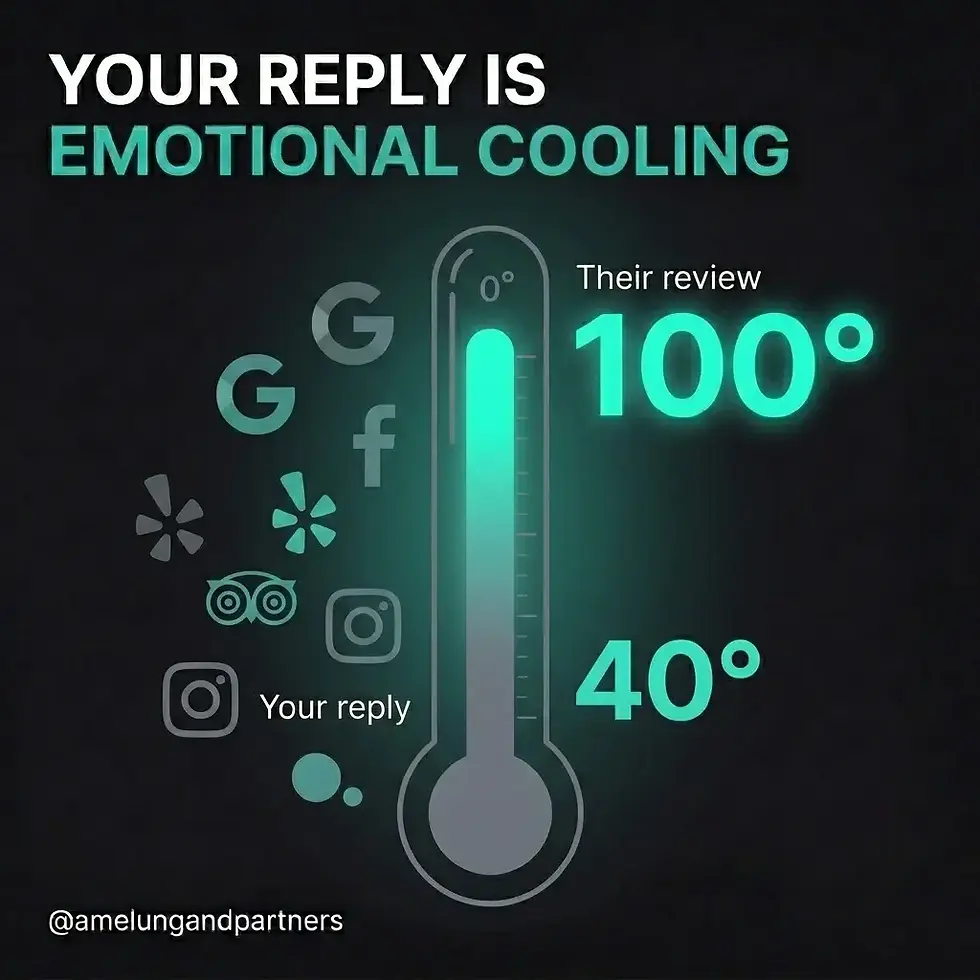
I call this emotional cooling.
The guest arrived at temperature 100. The response brought them down to 40.
Research from the Journal of Marketing confirms what I've seen: authenticity in emotional display matters more than volume. When customers perceive emotional displays as fake or disingenuous, conscious emotional contagion fails.
Translation: guests can tell when responses aren't genuine.
The standard response template does something worse than fail to build loyalty. It actively damages the relationship by signaling: "We didn't actually read what you wrote."
Touchpoints Versus Trustpoints
Most hospitality training teaches touchpoint optimization. Every guest interaction is a touchpoint. Maximize them.
I think about it differently.
Touchpoints become Trustpoints when the customers feels seen.
When a guest writes "10 stars" in their review, I acknowledge it. "Thank you—in a five-star environment, getting 10 stars is truly an honor. Especially from such an experienced traveler like you."
I pull their exact words. I mirror their language. I show I actually read what they wrote.
This isn't manipulation. It's basic human recognition.
Cornell research reveals something the industry keeps missing: revenue increases as response rates climb—but only up to about 40%. After that threshold, making too many responses becomes worse than offering no response at all.
The data is telling us something important: volume without authenticity damages performance.
The Three Mistakes Most Properties Make
Mistake One: Length asymmetry.
Guest writes three positive words. Hotel responds with a paragraph.
This isn't care. This is AI or marketing templates optimizing for SEO, not human connection.
It's like having a conversation where you tell a story and the other person suddenly starts talking about themselves. They stopped listening.
Mistake Two: Responding to negatives while ignoring positives.
Harvard studies show most hotels do this backward. They jump on negative reviews for damage control. They ignore positive ones.
But the Cornell data shows consumers prioritize responses to negative reviews over positive ones for trust building—while both matter for revenue. The mistake is treating positive reviews as less urgent when they're actually your revenue accelerators.
Properties that respond regularly to reviews receive 12% more reviews and see ratings rise by up to 0.5 stars within six months. That's not from responding to complaints. That's from maintaining consistent engagement across all feedback.
Mistake Three: Optimizing for positioning instead of connection.
When I see hotels writing long responses to short positive reviews, I know what they're doing. They're using the review as a platform to talk about themselves.
The guest becomes a prop in the hotel's marketing narrative.
This violates the basic principle of hospitality: the guest's experience comes first. Always.
When Silence Beats Performance
Not every review demands a response.
This idea makes most hospitality directors uncomfortable. The industry has adopted "respond to everything within 24 hours" as gospel.
But I've found that strategic non-response can demonstrate more authenticity than forced engagement.
When a review is generic—"Nice hotel, good location"—a templated response adds nothing. It's two pieces of automation talking to each other while future guests watch.
The research backs this up. Studies on emotional labor show that high-intensity emotional displays in mundane service interactions reduce perceived authenticity and trust. Overly enthusiastic responses to simple reviews can backfire.
Don't fill space with noise. We create conditions for people to exhale.
That philosophy extends to review management. Sometimes the most respectful response is none at all.
The Temporal Trap Nobody Talks About
Here's what the data reveals that most properties ignore: responding to negative reviews decreases short-term metrics before improving long-term performance.
Academy of Marketing Science research shows this clearly. Negative review responses (soothing the unsatisfied) cause temporary performance declines. Positive review responses (pleasing the satisfied) boost ratings and revenue immediately.
If your business operates on quarterly metrics, addressing negative feedback rationally hurts your numbers. So properties avoid it, even though long-term brand health depends on it.
The research proves this works: customers who receive responses to their reviews are nearly three times more likely to return. Dissatisfied customers who get genuine responses often become more loyal than guests who never had problems.
But you have to be willing to take the short-term hit.
The Personalization Paradox
Personalized responses work. Templates don't.
The problem: personalization doesn't scale through traditional methods.
Most properties solve this by not solving it. They choose templates because writing individual responses to hundreds of reviews seems impossible.
But I've found a different approach.
Systems can enable human warmth without scripts.
I use response frameworks. Framework for positive reviews:
Pull their exact words
Acknowledge specific details they mentioned
Match their emotional temperature
Keep length proportional to their review
End with genuine invitation, not corporate closing
Framework for negative reviews:
Acknowledge the specific problem without justification
Relate to a personal moment if possible
Offer concrete solution, not vague promise
Move serious issues offline immediately
Follow up privately after public response
This isn't automation. It's structure that protects authenticity at scale.
The difference matters. Research on emotional labor shows that surface acting (faking emotions) negatively impacts customer satisfaction, while deep acting (genuinely engaging) improves it. Customers detect the difference.
Frameworks help me engage genuinely with each review without starting from zero every time.
What Google Wants Versus What Guests Need
Google's algorithm rewards review engagement. Response rate and response time factor into local search rankings.
This creates a dual-optimization problem: satisfy the algorithm while maintaining genuine human connection.
Most brands fail by prioritizing the wrong audience. They write responses that check Google's boxes while cooling down the actual guest.
I've found the solution isn't choosing between them.
Authentic responses to real humans satisfy both.
When I write a response that makes the guest feel seen, it naturally includes the elements Google values: timely engagement, specific details, genuine interaction.
The inverse doesn't work. Responses optimized for algorithms fail guests and eventually fail Google too, because the algorithm is getting better at detecting authenticity.
Current data shows 88% of customers are interested in businesses' responses to reviews, and responding to feedback can boost customer spending by 35%.
But here's what matters: those customers aren't reading responses to evaluate your SEO strategy. They're reading to see if you actually care.
Measuring What Actually Matters
If I'm not optimizing for response volume or star ratings, what metrics indicate successful review management?
I track three things:
Response temperature match. Does my response maintain or elevate the emotional level of the original review? I want guests to feel more connected after my response, not less.
Conversation continuation rate. How many guests respond back after I reply? When someone writes "Thank you for understanding" or "I can't wait to return," I know the response worked. Silence after my response usually means I cooled them down.
Repeat booking correlation. I track which responded-to reviewers return. This tells me if my responses build actual relationships or just check boxes.
These metrics don't show up in standard reputation management dashboards. But they tell me if I'm turning touchpoints into trust points.
The industry measures response rate, average rating, review volume. Those matter for visibility. I measure whether guests feel seen. That matters for loyalty.
The Real Revenue Source
The 33% revenue increase from review engagement isn't magic.
It comes from a simple mechanism: when guests feel genuinely recognized, they spend more, return more often, and tell more people.
But most properties miss this because they're optimizing for the wrong outcome.
They see review management as reputation defense. I see it as relationship building.
They write for algorithms and future prospects. I write for the person who just stayed with us. They cool guests down with templates. I try to keep the temperature high with recognition.
The research shows templated responses lose effectiveness as competitors adopt similar strategies. We're in an authenticity arms race now.
The properties that win won't be the ones with the most responses. They'll be the ones where guests feel actually seen.
That's not a hospitality tactic. That's basic human respect.
And it happens to drive 33% more revenue. Listen to full Podcast episode


